
The window seat is the sunniest seat in the house — which is exactly why it's where ordinary cushion fabric fades first. How to get one that fits the ledge and keeps its colour.
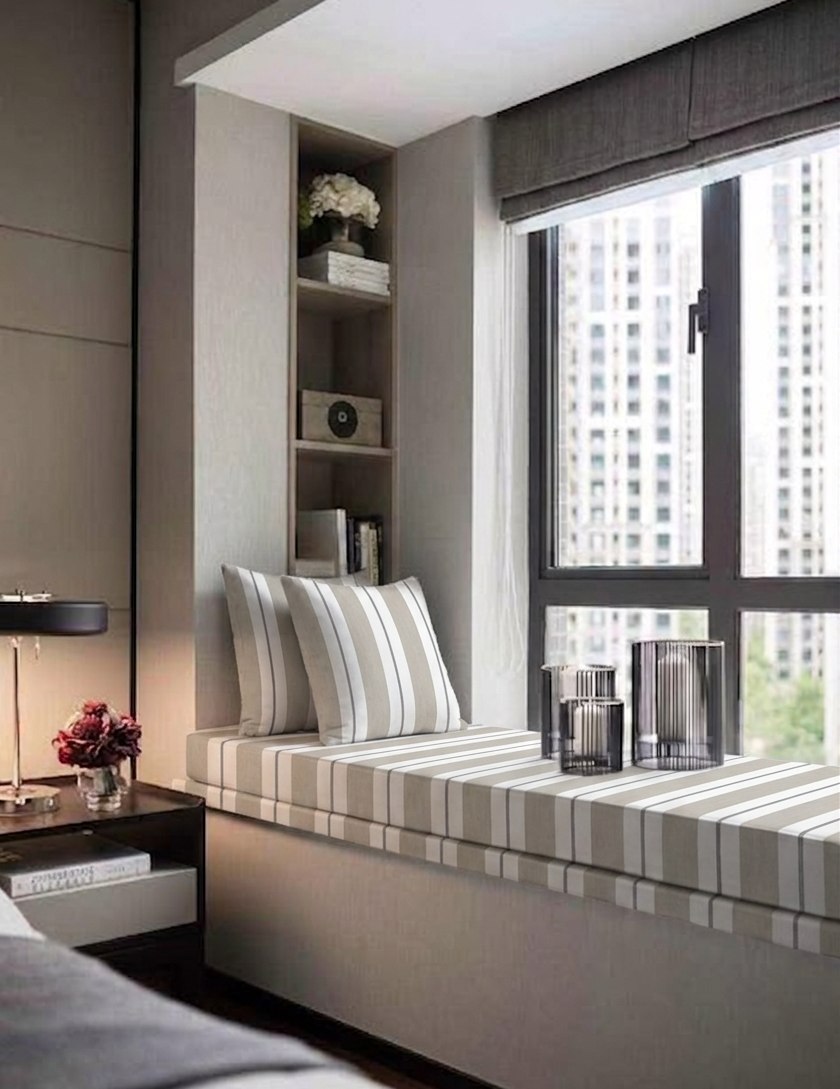
A built-in window ledge with a striped cushion cut to its exact length and depth.
Short answer: a window seat cushion needs three things an ordinary sofa cushion doesn't — fabric that won't fade behind glass, an exact fit to a built-in ledge, and enough firmness to sit on for hours without bottoming out. Get those right and the window seat becomes the most used spot in the room. Get them wrong and it becomes a ledge with a faded pad on it.
A window seat sits in direct light for hours every day, all year. Window glass filters out most UV-B, but UV-A — the wavelength behind most fabric fading — passes through largely unaffected. That is why a window seat cushion can take a harder light beating over a year than a cushion on a covered patio.
Ordinary upholstery fabric is printed or piece-dyed: the colour sits on the surface of the fibre, and sunlight breaks it down from the top, often within a season or two. Sunbrella is solution-dyed, so the colour runs through the whole fibre and there is no surface layer to bleach out. That's the property that lets a window seat cushion go bold — deep charcoals, saturated stripes, strong blues — without the usual fading trade-off. We cover the mechanism in more depth in what actually wears out outdoor fabric.
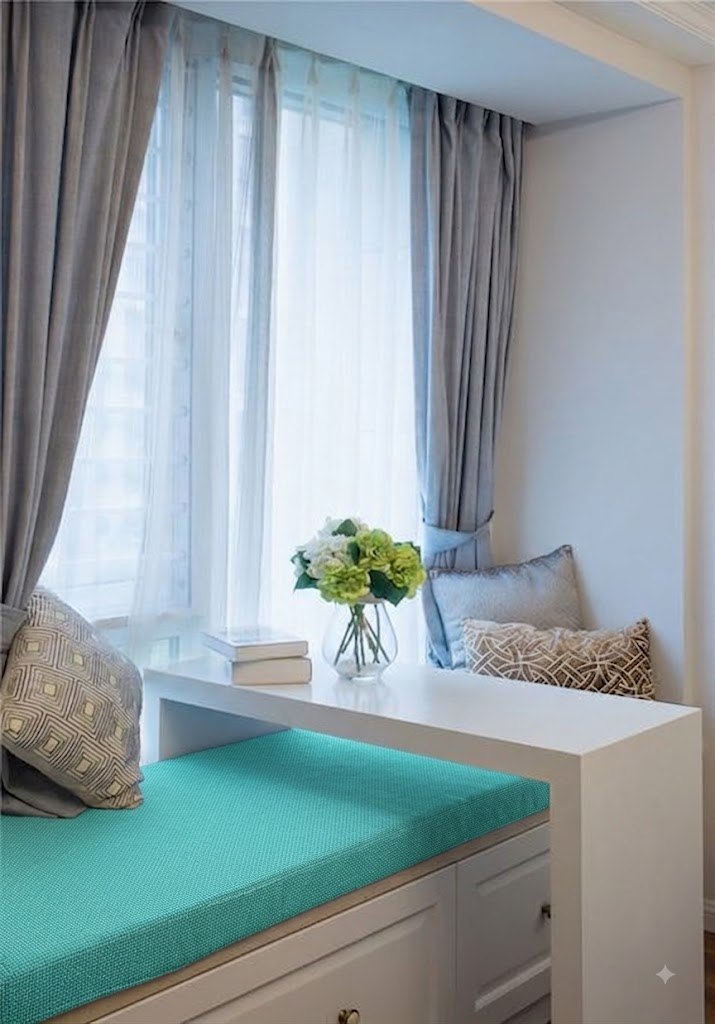
A quiet stripe for a city apartment ledge (left) and a single saturated turquoise (right) — both in sunlight all day.
Built-in ledges are rarely perfectly square, especially in older homes or where walls have been plastered. Measure the length at the front, middle and back, and the depth at each end, then use the smallest of each. If the ledge sits in a recess, measure wall to wall. If one end is open, decide whether you want the cushion flush with the edge or stopping a couple of centimetres short — flush looks built-in; stopping short looks softer.
If the ledge is angled (as in a true bay with three faces), it is usually neater to make one cushion per face than to chase a single odd shape — each face becomes a simple rectangle, and the seams line up with the corners of the window. Our full measuring guide walks through the process step by step.
Window seats are for lounging, so they usually suit a deeper cushion than a dining bench does. Check two things before you pick a thickness: that the finished cushion still clears the window frame or sill when you sit back, and that any window handle or latch is still easy to reach.
High-density foam keeps its shape under daily use far better than soft foam, which is what you want on a seat that gets sat on every evening. On Cushiere, every seat cushion can be ordered with a high-density foam insert cut to the same dimensions as its cover, or as cover only if your existing foam is still in good shape.
A piped edge gives a crisp, tailored line that suits built-in joinery and holds a box shape well. A plain edge looks softer and more relaxed — closer to a daybed mattress. Neither is more practical than the other; it is mostly about whether the room leans tailored or relaxed.
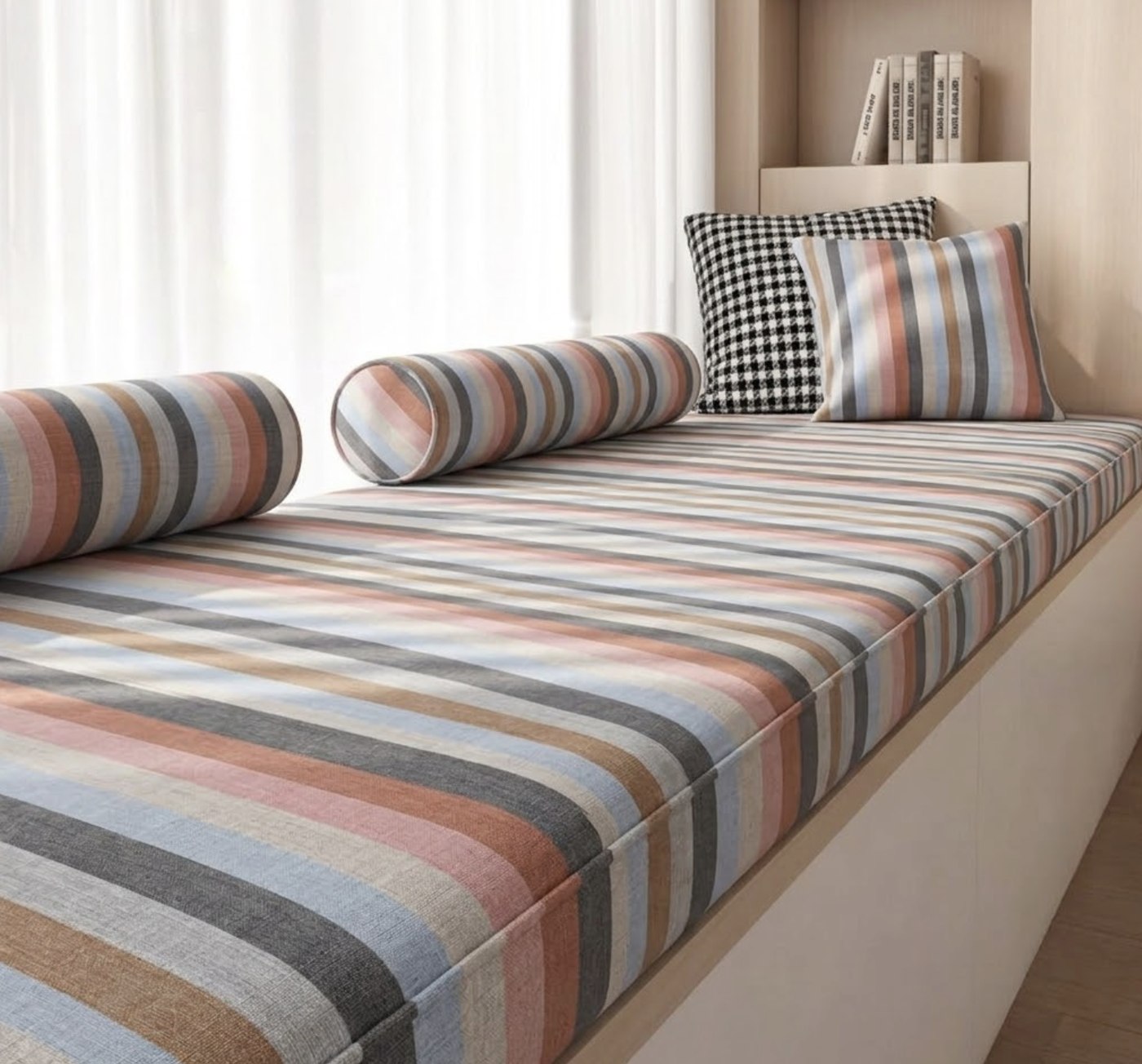
A multi-stripe seat with matching bolsters — pattern holds up in full sun when the colour runs through the fibre.
Quiet neutrals such as Relate Linen, Sailcloth Sahara or Cast Ash let the view do the talking and suit a seat that doubles as extra sofa space.
Stripes such as Peyton Granite or Cabana Classic make a long ledge look intentional, and they run naturally along the length of the cushion.
One strong colour — Canvas Navy, Canvas Pacific Blue, Canvas Terracotta — turns the window into the room's focal point. Because the colour is solution-dyed, the sun is less of a risk than people expect.
Whatever you choose, add a couple of back or scatter cushions against the wall: they make the seat comfortable to lean on and let you bring in a second colour without committing the whole seat to it.
Indoors, a window seat mostly collects dust and the occasional spill. Brush or vacuum the cover now and then; most marks on Sunbrella lift with mild soap and water. Flip and rotate the cushion every few months so it wears evenly.
Do window seat cushions fade behind glass?
Ordinary fabric does. Glass blocks most UV-B but lets most UV-A through, and UV-A causes most fading. Solution-dyed fabric like Sunbrella has colour through the whole fibre, so it resists fading far better.
How do I measure a bay window seat?
Measure the length and depth of the ledge in a few places and use the smallest numbers. For a three-faced bay, make one rectangular cushion per face rather than one odd-shaped cushion.
Can I use outdoor fabric indoors on a window seat?
Yes. Sunbrella performance fabric works equally well indoors, and its fade and stain resistance suits a sunny window seat.