
A sectional is several pieces of furniture pretending to be one. How we cut, fill and tailor cushions so the whole thing reads as a single, built-in lounge.
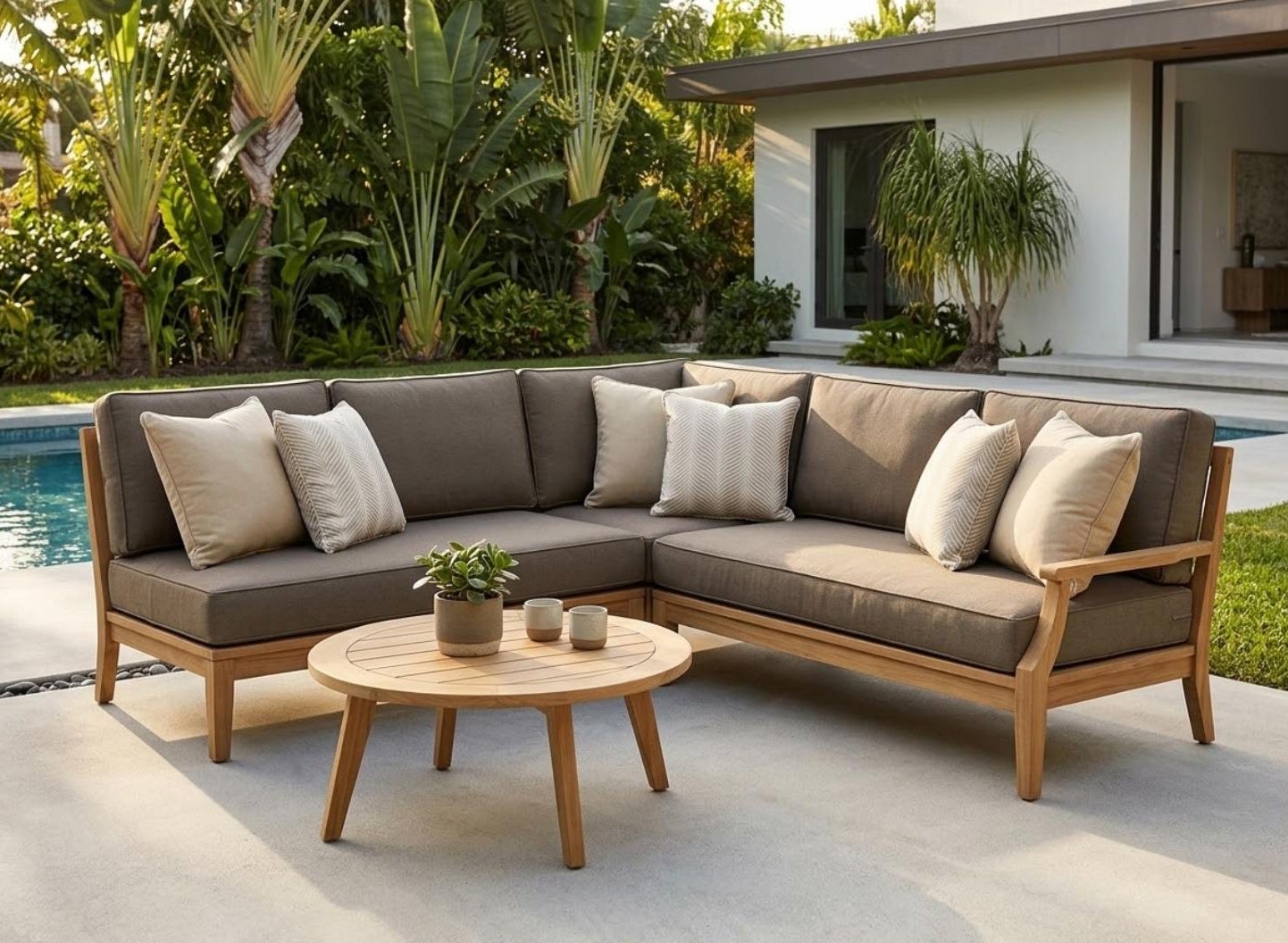
An L-shaped teak sectional with one cushion cut for every position.
Short answer: custom outdoor sectional cushions fit properly when every module gets its own cushion cut to that module's exact length, depth and thickness — not one standard size forced across corners and chaise ends. Pair that with a deep, high-density foam core, box-edge tailoring with welt seams, and a fabric scheme of one solid base plus patterned scatters, and an L-shaped or modular sectional looks built-in rather than bought.
A sectional is several pieces of furniture pretending to be one. The corner unit is square, the armless middles are often a few centimetres narrower than the end pieces, and a chaise or ottoman can be deeper again. Off-the-shelf replacement cushions come in a handful of sizes, so on a sectional you end up with gaps at the joins, cushions that overhang the frame, or a corner that never quite lines up.
Made-to-measure solves this by treating each position as its own rectangle. Measure every seat and every back separately, write them down in order around the L or U, and order one cushion per position. Our measuring guide covers the details: measure the frame at front, middle and back, use the smallest figure, and measure your old foam (not the old cover) if you're replacing covers only.
Our first lounge concept is a classic L-shaped teak sectional beside a pool: five seat positions, a corner, and a low round coffee table in the middle.
L-shaped teak sectional: Canvas Taupe seats and backrests, Canvas Antique Beige scatters, Clock out Cloud chevron accents.
Fabrics. Canvas Taupe on every seat and back cushion — a warm grey-brown that sits naturally against honey-toned teak and doesn't show the daily wear of a much-used poolside lounge. Canvas Antique Beige on the tailored scatter pillows lifts the scheme, and Clock out Cloud, a pale wavy chevron, adds movement without bringing in a new colour.
Construction. A 15cm high-density QuickDry reticulated foam core — an open-cell foam that lets water drain straight through rather than holding it like a sponge, so cushions dry quickly after rain or a wet swimsuit. Seams are finished with ½" matching welt cord for a crisp box edge, and covers close with concealed heavy-duty YKK outdoor zippers, so they come off for cleaning and go back on neatly.
The second sectional concept goes bigger: a deep, armless modular sectional wrapped around a travertine terrace, with an ottoman in the middle and a linear fire pit alongside.
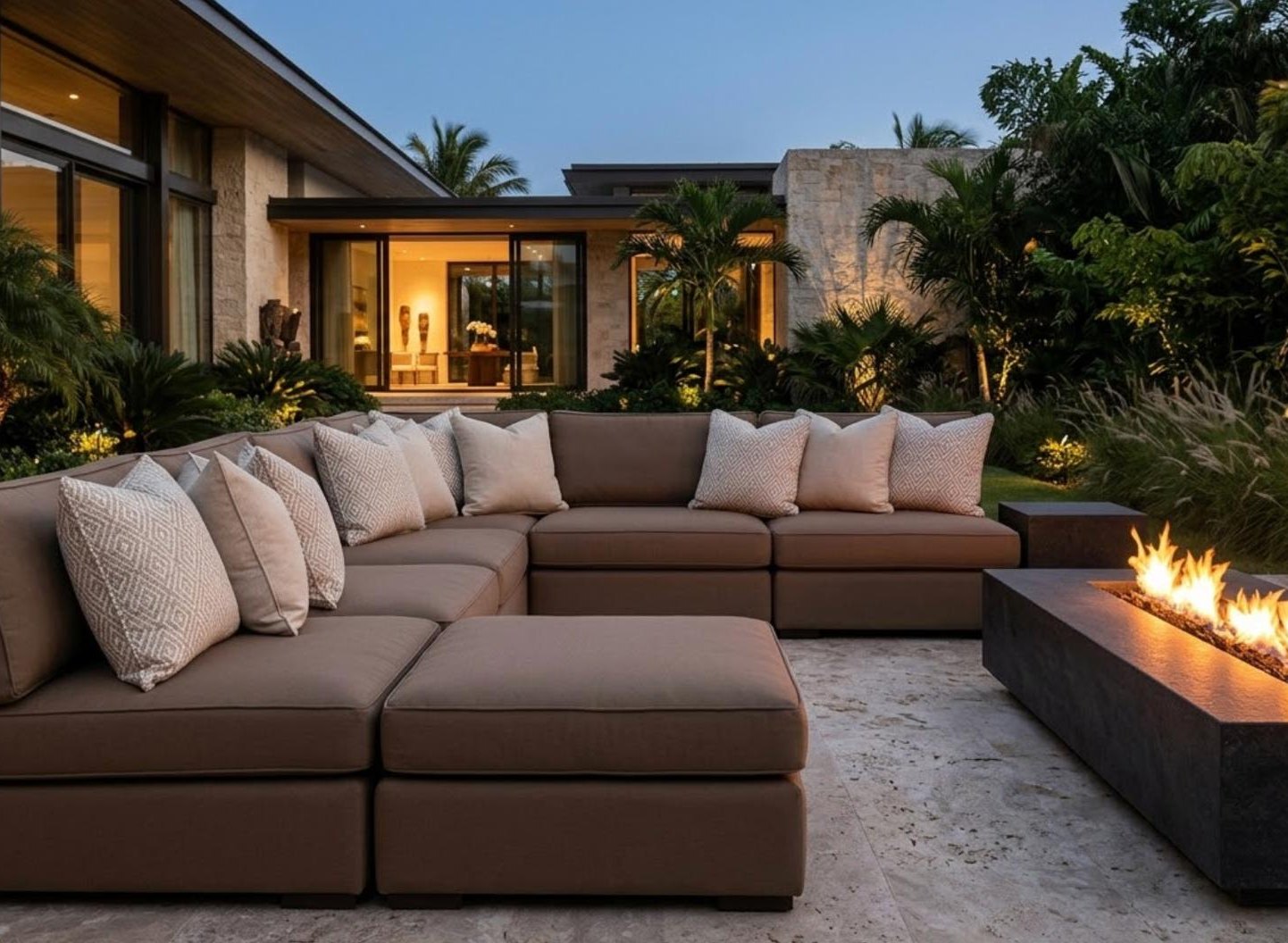
Villa modular sectional: Canvas Taupe box-edge seating and welt, Detailed Linen diamond jacquard and Canvas Antique Beige scatters.
Fabrics. Canvas Taupe again on the box-edge seating and its welt, so the whole sectional reads as one continuous piece in the evening light. The scatters alternate Detailed Linen — a cream diamond jacquard — with plain Canvas Antique Beige, which keeps a long row of cushions rhythmic instead of busy.
Construction. Oversized 18cm foam depth for a true deep-seating, sink-in feel, with reinforced corner darts so the box shape stays square at the corners rather than rounding off. Internal tie-downs hold each cushion in place on its module, which matters on an armless modular sectional where there is nothing at the ends to stop cushions creeping apart.
It depends on how the frame is built and how you want it to sit:
Before you order, check that the new thickness still leaves comfortable seat height and that back cushions don't push the seat depth too shallow. If your old cushions felt right, matching their thickness is usually the safest choice.
Both sectional concepts use a box-edge cushion: a top panel, a bottom panel and a side band (the boxing) joined at sharp corners. A welt cord along those seams is what gives a sectional its tailored, upholstered look. A matching welt (same fabric as the cushion) looks quiet and architectural; a contrast welt — say, Canvas Antique Beige on Cast Ash — outlines each cushion and makes the seating look more crafted. Every Cushiere seat cushion can be ordered with a piped edge or a plain edge, and our seams are double-stitched with UV-stabilised, high-tenacity thread.
Keep the solid base on the seats and backs, because that's most of the fabric and most of the wear. Put pattern on the scatters, where it's easy to change later. And repeat each scatter fabric at least twice across the sectional so it reads as deliberate. Our neutral Sunbrella lounge palette lays out all nine fabrics and how they pair; for a coastal take on the same idea, see deep-seating cushions for coastal decks and terraces.
Because every fabric is Sunbrella solution-dyed acrylic, the colour runs right through the fibre, so a long run of taupe cushions fades far more slowly and evenly than printed or piece-dyed fabric. That matters on a sectional: if one cushion fades faster than its neighbours, the whole set looks mismatched.
How do I measure cushions for an outdoor sectional?
Measure each seat and back position separately: length and depth at the front, middle and back, using the smallest figure. Order one cushion per position rather than one standard size across the whole sectional.
How thick should outdoor sectional cushions be?
Around 15cm suits a framed sectional with visible arms; around 18cm suits an armless modular sectional on a low base, where the cushion provides most of the seat height.
What is a box-edge cushion?
A cushion made from a top panel, a bottom panel and a side band joined at sharp corners, usually finished with welt cord along the seams for a tailored, upholstered look.